
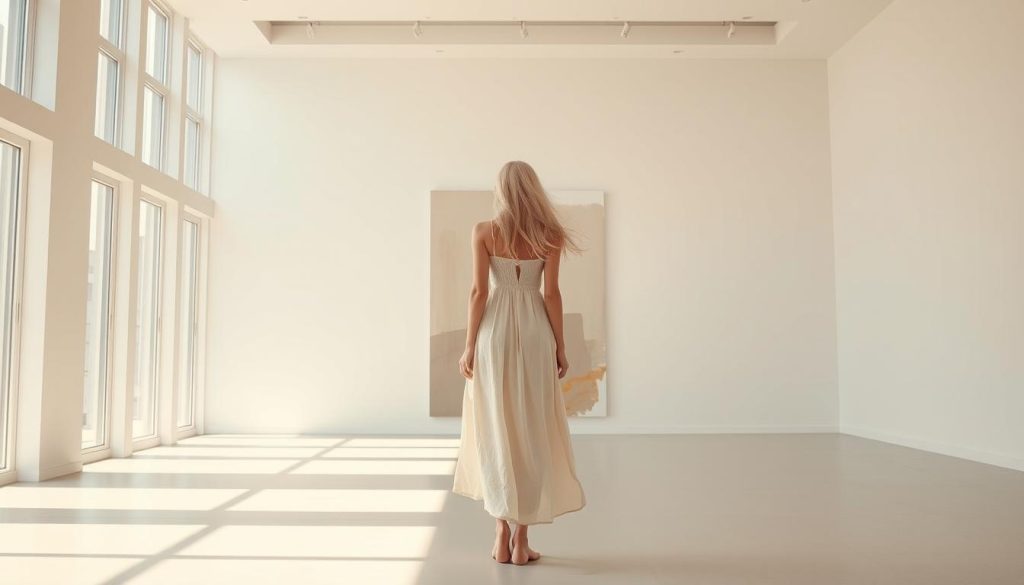
Minimalism in Art What if less truly changed everything? I ask that because a bold, pared-down approach flipped how we see objects and space!
You’re about to get a clear, energizing roadmap to the mid-1960s wave that hit New York and shook the art world. This movement replaced hand-made gestures with industrial assembly and cool geometry.
We’ll meet key artists and iconic works that rethought painting and sculpture. You’ll see how the idea of the specific object shifted focus from story to presence.
This intro sets the scene for how modern art returned to essentials, rooted in early geometric abstraction and pushed forward by strict forms and repeated modules. Get ready to spot its fingerprints everywhere!
Key Takeaways
- You’ll learn how the 1960s reshaped the art world with clean, industrial work.
- The movement put the whole work above narrative and personal drama.
- Artists used geometry, repetition, and factory methods to make impact.
- Painting and sculpture were redefined by scale, edge, and presence.
- You’ll leave ready to recognize major names and signature pieces.
Introduction: Why Minimalism in Art Still Shapes the Modern Art World
Here we’ll see why simple geometry and clear form still drive how we shape visual culture! I want you to notice how this art favors lines, color, and geometry over depiction.
This idea moves fast beyond the gallery. It touches music, architecture, design, fashion, and photography. That cross-pollination helped the movement become a language for makers and brands!
Some people call it spare or cold. Others praise its discipline and focused presence. You’ll learn how artists used abstraction to drop narrative and invite pure experience. That clarity keeps the style alive over time.
“Less can make you see more—every line, every space, every material counts.”
- Clean geometry still guides product and interior design.
- Simple forms teach us to slow down and notice.
- The movement stretched into sculpture, light work, and whole buildings.
| Area | Impact | Example |
|---|---|---|
| Design | Cleaner branding and interfaces | Modern product lines |
| Architecture | Focus on space and form | Minimal houses and galleries |
| Music & Photography | Reduction to essentials | Sparse scores, stripped images |
Early Modernist Roots: Geometry, Abstraction, and the Search for Essential Forms
Early 20th-century pioneers carved the visual language that would shape later reductionist movements! You’ll see how simple shapes and strict choices rewired how artists worked and how viewers looked.
Kandinsky, Kupka, and Hilma af Klint: Early Experiments in Non-Objective Art
Hilma af Klint made nonobjective works as early as 1906, ahead of Kandinsky and Kupka’s experiments around 1910–1913. Their paintings pushed past depiction and tested how abstraction could hold spiritual and visual force.
Mondrian and De Stijl: Lines, Primary Colors, and Geometric Shapes
Mondrian used intersecting black lines and blocks of red, yellow, and blue to hunt for harmony. His work turned lines and colors into a clear, almost musical system!
Malevich’s Black Square and Suprematism: The Supremacy of Pure Feeling
Malevich’s 1915 Black Square was a shock—an icon placed in the corner to state pure feeling. That radical reduction reset what a painting could be.
The Bauhaus: “Less is More” and Form-Follows-Function Design
The Bauhaus fused craft, design, and theory. Mies van der Rohe’s motto “less is more” echoed a training that shaped how makers thought about purpose and form.
Constructivism: Rodchenko, Lissitzky, and Architecture as Sculpture
Constructivists treated architecture like sculpture and celebrated factory methods. Rodchenko’s Pure Red/Blue/Yellow (1921) stripped imagery away and embraced radical monochrome as a statement.
- You’ll trace how lines, squares, and shapes became tools for clarity!
- These movements built a language that later artists amplified.
| Movement | Key Artist(s) | Core Element | Legacy |
|---|---|---|---|
| Non-objective | Hilma af Klint, Kandinsky | Spiritual abstraction | Freed painting from depiction |
| De Stijl | Mondrian | Lines & primary colors | Systems of harmony |
| Suprematism | Malevich | Black square, pure feeling | Radical reduction |
| Constructivism & Bauhaus | Rodchenko, Lissitzky, Mies | Industrial forms, function | Architecture as object; design discipline |
American Abstract Artists and the Interwar Foundations
Bold experiments by small American collectives turned studios into labs where form and color were tested and taught! You’ll see how a resilient network pushed abstraction forward when it was still controversial.
The American Abstract Artists (founded 1936) rallied painters and sculptors to defend non-figurative practice. The group included many women artists and gave exhibitions, journals, and talks that kept abstraction visible across the United States.
Josef Albers and Homage to the Square: Color as structure
Josef Albers taught at Black Mountain College and Yale. His Homage to the Square series (from 1949) nested squares to show how colors shift by relation. These paintings became hands-on lessons about perception!
Broadening the field: Burgoyne Diller, Ilya Bolotowsky, and a new language of form
Diller and Bolotowsky expanded geometric order across paintings and public programs. They translated European systems into a distinctly American approach to composition and scale.
- You’ll discover how a brave interwar group kept abstraction alive when it wasn’t yet popular!
- You’ll learn how these artists turned painting into a lab for structure and color interaction!
- You’ll notice how teaching, community, and shared values planted the seeds for later movements!
“Small groups with clear vision can change the conversation about what art can be.”
| Group / Artist | Role | Contribution |
|---|---|---|
| American Abstract Artists | Collective | Promoted exhibitions, journals, and inclusion of women artists |
| Josef Albers | Teacher / Painter | Homage to the Square: rigorous color experiments |
| Burgoyne Diller & Ilya Bolotowsky | Painters | Systematized geometry; bridged Europe and U.S. modern art |
From Abstract Expressionism to Reduction: The Pared-Down Sublime
This shift tightened big feeling into quiet power! You’ll see how two artists cut through drama to make presence the point.
Barnett Newman’s zips and the immersive field of color
Newman’s Vir Heroicus Sublimis (1950–51) is huge—about 8 × 18 feet. The vertical “zips” split the canvas and ask you to stand close. The work floods you with color. It creates a charged stillness that hints at later minimalism!
Ad Reinhardt’s ultimate paintings: Toward art-as-art
Reinhardt went darker and quieter. His nearly-black paintings hide subtle squares. He called them “ultimate” and wanted art to be art—no story, no gesture. That refusal of drama sharpened focus and changed the way we look at painting.
- Scale and proximity make these works almost meditative.
- The move away from raw expressionism opened a new way to engage.
- You’ll notice how less pushes you to pay closer attention!
“A canvas becomes a field for perception itself—no story, just seeing.”
Prelude to Minimalism: Proto-Minimalist Painters and Sculptors
Before the term took hold, several painters and sculptors were already testing spare forms and strict rules. You’ll meet pioneers who pushed shape, surface, and repetition to the edge!
Ellsworth Kelly’s hard edges and shaped canvases
Kelly’s crisp geometry began in the 1950s. His shaped canvases made color feel architectural and bold.
Robert Rauschenberg’s white and black monochromes
Rauschenberg stripped images to multi-panel white and black fields. He challenged what counts as an image!
Robert Ryman’s surfaces: Canvas as object
Ryman treated the canvas as a present object. Surface, brushwork, and texture became the subject itself.
Agnes Martin’s grids: Ineffability and restraint
Agnes Martin used faint graphite lines and soft washes. Her quiet grids whisper calm and discipline.
Yayoi Kusama’s nets and seriality
Kusama’s net fields (from 1957 NYC) repeated marks to make endless space. Seriality became a visual chant.
Frank Stella’s Black Paintings
Stella’s 1959 black enamel bands declared, “What you see is what you see.” His work demanded direct looking.
The Washington Color School
Artists like Noland and Gilliam used stripes and roundels to make color into structure. These paintings tied hue to form.
“A wave of simple experiments can change how a whole world sees shape and color.”
- You’ll see how these artists built a new language of shapes and restraint!
- Notice how seriality and surface lead to clarity!
| Artist / Group | Core Move | Impact |
|---|---|---|
| Ellsworth Kelly | Shaped canvas, hard-edge color | Color as architecture |
| Rauschenberg | White/black monochrome panels | Questioned image and absence |
| Robert Ryman | Tactile monochrome surfaces | Canvas as object |
| Agnes Martin | Graphite grids, soft washes | Ineffable calm |
Minimalism in Art: Defining the Movement in the 1960s
The mid-1960s New York scene rewired how makers thought about shape, surface, and scale! I want you to feel how the work moved toward industrial fabrication and rectilinear forms.
Core idea: artists rejected private drama and prioritized the specific object. These pieces sit as themselves—neither pure painting nor pure sculpture.
Serial presentation and repeated modules gave rhythm and clarity. Stacks, boxes, and rows created momentum you could walk around and measure with your body.
- You’ll learn the core principles that made this movement feel decisive and new!
- See how city workshops and fabricators shaped materials and finish!
- Understand how curators and critics amplified the scene through shows and texts!
“What counts here is presence: material, edge, and how a form meets space.”
Takeaway: This style changed modern art by dropping biography and metaphor. It taught you to look, move, and experience with fresh attention!
Donald Judd and the “Specific Object”
Judd’s work turns simple volumes into compelling statements you can walk around. He insisted that an object should be itself—honest, direct, and present!
Boxes and stacks varied by scale and finish. He used plywood, concrete, galvanized steel, copper, and colored Plexiglas. Many pieces appear in serial rows or stacked towers. Fabrication was precise. That craft made each sculpture feel crisp and lucid.
Boxes, stacks, and industrial materials: Plexiglas, steel, and plywood
You’ll notice color arriving through Plexiglas and lacquer, not brushwork. The materials announce themselves. The result reads like design and like work of an artist at once!
From SoHo to Marfa: Space, site, and permanent installation
Judd transformed a SoHo building into a living gallery. Then he forged Marfa into a long-term site for permanent installation. These moves show how space shapes meaning over years, not just moments.
“The specific object asks you to stand, to move, and to see the thing as itself.”
- You’ll see how serial stacks stretch attention rhythm by rhythm!
- You’ll learn why Judd preferred the specific object—clear and direct!
- You’ll feel how site and scale change what a piece can mean!
Dan Flavin: Drawing with Light
Flavin turned store-bought fluorescent tubes into pure, glowing grammar! You step into a room and the light becomes the subject. The work frames edges, corners, and planes so the space talks back to you.
He used standard fixtures and colored tubes to make simple grids, corner pieces, and luminous lines. These choices erase traditional boundaries between painting and sculpture.
Fluorescent tubes, color, and phenomenological space
Flavin often resisted the label of minimalism and linked himself to long light traditions. He referenced landscape painting and focused on the viewer’s sensory experience.
- You’ll step into glowing rooms where light itself becomes the medium!
- See how off-the-shelf tubes craft radiant forms and sharp spatial edges.
- Feel colors as atmosphere, not as painted surfaces, shifting how you move.
- Notice how simple modules—lines and corners—reshape your sense of scale.
“Change the light, change the way you experience the world.”
Takeaway: Flavin makes ordinary materials feel like revelation. The appearance of the object is the light you live inside. His clarity shows how a tiny gesture can alter an entire space and your attention!
Sol LeWitt: Ideas, Systems, and Modular Forms
Sol LeWitt turned rules into playful systems that pack big visual energy into simple parts! You’ll find clarity and joy at the heart of his practice.
LeWitt built open cubes and progressions from wood, later steel, and painted them white. He used standardized ratios so each piece fits a strict system. The result reads like a score you can move around and feel.
Open cubes, progressions, and instruction-based wall drawings
His wall drawings were written as instructions. Others executed them. That choice separated the idea from the making.
Conceptual crossover: object versus idea
The concept leads and hands follow. This approach bridged minimalism and conceptual practices. It made the plan as important as the finished sculpture or painting.
- You’ll see systems that repeat, shift, and surprise!
- Simple modules become lively when stacked or sequenced.
- Ideas can create endless variations—try one and see!
| Element | Material | Effect |
|---|---|---|
| Open cubes | Wood → Steel, painted white | Architectural clarity; walkable rhythm |
| Progressions | Standardized ratios | Perceptual change with scale |
| Wall drawings | Instruction sheets | Idea-first execution; collaborative making |
| Legacy | – | Links systems, artists, and viewers through rules |
“When the idea is the machine, the work becomes a system you can follow.”
Other Pioneers of Minimal Sculpture
Several sculptors pushed raw matter into bold, physical gestures that ask you to move differently! You’ll meet artists who used basic elements and strict choices to make presence felt. These works teach you to slow down and feel the space.
Carl Andre’s floor works and the “turner of matter”
Carl Andre laid simple units across the floor. Lever (137 firebricks, 1966) stops your walk and changes the path. Andre wanted to “sever matter from depiction.” The object becomes route and thought.
Tony Smith’s Die and human scale
Tony Smith made a six-foot steel cube. Die matches your body. It is not grand, nor tiny. You stand beside it and reassess scale. The piece remaps how you use space.
Robert Morris’s mirrored cubes and perception
Morris used mirrors to fold viewers into the work. His cubes reflect you and the room. His essays also shaped the wider conversation. Seeing becomes active and social.
Richard Serra’s mass, gravity, and risk
Serra stacked lead plates in One Ton Prop. Mass, balance, and implied danger make the moment electric. The work feels risky and controlled at once.
- You’ll walk with Andre and test your pace!
- Stand with Die and feel your scale shift!
- Face Morris’s cubes and meet your reflection!
- Sense Serra’s weight and the thrill of balance!
These artists show how simple materials and clear decisions unlock powerful presence and teach you to trust your senses!
Minimalism and Painting: Marden, Mangold, and Jo Baer
A few artists turned paintings into physical presences you can study like a sculpture—quiet, tactile, precise! You’ll notice how surface, edge, and format become the message.
Monochrome panels and encaustic surfaces
Brice Marden used encaustic wax on large panels. His diptychs and triptychs glow with layered sheen. The wax gives color a subtle depth and a hushed energy you can feel up close.
Shaped canvases, lines, and tension between form and space
Robert Mangold carved gentle shapes out of the canvas and inscribed spare lines. Those lines guide your eye between curve and edge. Classical balance meets modern restraint!
Edges, frames, and the painting as object
Jo Baer framed white fields with narrow colored bands. The band becomes a border and a presence. The canvas stops being a window and starts being an object you examine.
- You’ll see how painting stays tactile and direct!
- Feel waxy panels, shaped canvases, and colored edges pull your attention!
- Notice how line, edge, and surface carry the form—no story required!
“Look at the edge; the decision is there.”
Core Characteristics and Key Principles
What ties these pieces together is a focus on rhythm, material, and scale. I want you to feel how the movement favors repeatable parts, clean geometry, and plain presence over story or biography!

Repetition and seriality
Repetition builds a steady pulse you can walk beside. Rows, stacks, and modules set a beat that trains your eye and your pace.
Serial works reveal tiny shifts—color, space, or spacing become the content. These patterns give rhythm and a quiet intensity!
Geometric form and non-objective appearance
Geometric clarity rules. Simple forms and crisp edges remove narrative and point you to pure abstraction.
Look for balanced shapes and repeated geometry that act like a score. The work reads as structure, not story.
Material presence over metaphor and biography
Materials speak here. Steel, Plexiglas, wood, and light state their truth. The object is the idea—no backstory needed.
That insistence on matter makes the viewer respond bodily. Weight, scale, and surface become the lesson you live!
- You’ll lock onto the traits that make this movement unmistakable and powerful!
- Notice how clear forms and serial structures invite calm and close attention!
- Let these concepts push you to cut noise and focus on what matters!
| Trait | Material | Effect |
|---|---|---|
| Serial modules | Wood, steel | Rhythm; subtle variation |
| Geometric forms | Plexiglas, painted surfaces | Non-objective clarity |
| Material focus | Industrial finishes | Presence over metaphor |
“The work is what it is—stand, move, and see.”
Materials, Fabrication, and the Industrial Turn
Prefabricated metals and plastics let artists scale work quickly and achieve razor-clean surfaces. You’ll see how shop-made parts and pro finishers replaced studio carpentry. That shift changed the look and the logic of the work!
Prefabrication, hardware stores, and fabrication shops
Artists started sourcing parts from hardware stores and local fabricators. They wrote plans, then handed them off to pros.
This cut making time and kept serial modules consistent. It also made the finished work read as industrial, not handmade!
Aluminum, fiberglass, Plexiglas: Surface, finish, and color
Aluminum, fiberglass, and Plexiglas offered smooth planes and uniform color. These materials reflect light and shape perception.
Finish matters: lacquered edges, mirrored surfaces, and factory paint set a precise appearance that signals design as much as craft.
Space, scale, and the viewer’s bodily encounter
Scale and placement turned pieces into environments. You move around rows, stacks, and panels and your body reads the form.
That physical encounter blurred sculpture, architecture, and installation. The viewer became part of the work’s effect!
“When the maker uses industrial tools, the object speaks clearly — no disguise, just presence.”
- You’ll notice how fabrication shops fueled a new art-making economy!
- You’ll learn why honest materials build trust with the viewer!
- Let this inspire you to choose materials with intention and clarity!
| Material | Characteristic | Effect on Work |
|---|---|---|
| Aluminum | Lightweight; rigid | Sharp edges; reflective planes |
| Plexiglas | Translucent; colored options | Color and light become structural |
| Fiberglass | Moldable; smooth finish | Monolithic surfaces; consistent sheen |
| Fabrication shops | Professional finishing | Repeatability; design-level polish |
Key Artworks that Defined a Movement
Six landmark works prove that scale, surface, and repetition can teach you how to see. Each piece is direct. Each piece asks you to stand, move, and notice!
Frank Stella — Die Fahne Hoch!
Stella’s black enamel stripes reveal raw canvas between the bands. The lines push your eye to edges. The title causes debate, though Stella denies political intent.
Tony Smith — Die
This six-foot steel cube ties scale to the human body. Stand beside it and your sense of size shifts. Presence becomes the lesson!
Carl Andre — Lever
Andre laid 137 firebricks projecting from the wall. The simple units reroute how you walk. The floor becomes part of the sculpture.
Robert Morris — Untitled (mirrored cubes)
Mirrored cubes reflect you and the room. Seeing yourself inside the work makes awareness the subject. The effect is active and social.
Donald Judd — Untitled (stacks)
Judd’s wall stacks repeat industrial modules. Repetition turns parts into rhythm and order. The object reads as itself, clear and concise.
Richard Serra — One Ton Prop (House of Cards)
Four 500‑pound lead plates lean on weight alone. Gravity becomes a raw, thrilling force. The risk and balance feel immediate!
“Reduce, repeat, and let materials show their truth.”
| Work | Artist | Key trait | What you learn |
|---|---|---|---|
| Die Fahne Hoch! | Frank Stella | Black enamel stripes | Edges and canvas reveal the work |
| Die | Tony Smith | Six-foot steel cube | Scale tied to the body |
| Lever | Carl Andre | 137 firebricks | Movement and route made by matter |
| One Ton Prop | Richard Serra | Leaning lead plates | Gravity as structure |
- You’ll tour six iconic pieces that crystallize bold clarity!
- Use these works as anchors to spot this style anywhere you go!
Minimalism’s Spread: West Coast Light and Space, Finish Fetish, and Beyond
California makers chased light, lacquer, and ultra-smooth finish to push perception forward! You’ll head west to see how regional settings changed the way work looks and feels.
Finish Fetish borrowed shop polish from auto-body and aerospace tech. John McCracken’s glossy planks lean like painted beams. They hover between painting and sculpture with cool confidence.
DeWain Valentine cast huge resins that glow. His translucent surfaces catch and hold light. They feel like captured sunsets that change as you move!
Light and Space artists made rooms where light acts like architecture. James Turrell builds spaces of pure glow that alter depth and scale. Mary Corse mixes microspheres into paint so panels shimmer and become active fields of vision.
- You’ll notice glossy materials and shop-made finish shaping appearance and perception!
- Regional approaches bend core movements into fresh styles and design logic!
- Look west for sheen, light, and material experiments that changed the world way artists work!
| Region / Artist | Materials | Key effect |
|---|---|---|
| West Coast — John McCracken | High-gloss lacquered planks | Lean between painting and sculpture; cool confidence |
| West Coast — DeWain Valentine | Cast resin | Translucent, luminous surfaces |
| West Coast — Turrell & Corse | Light installations; microsphere paint | Perception-shaped space; shimmering panels |
| Germany — Gerhard Richter | Reverse-painted glass; color charts | Systematic gray panes; schematic color logic |
“Same clarity, new contexts — watch how materials and place change the way you meet a work.”
Dialogues, Critics, and the Art World
The 1960s saw heated conversations that changed how viewers meet objects and paintings! Critics pushed theories and artists pushed back. That friction made the scene electric.

Against Greenbergian formalism: Painting versus object
Many makers rejected Clement Greenberg’s strict view that each medium should stay inside its lane. They blurred painting and object on purpose.
This move shifted focus from gesture to presence. The result opened new ways to think about work and space.
Museums, dealers, and publications in the 1960s–1970s
Curators and galleries staged bold shows that made ideas public fast! Dealers backed young talent and trade magazines spread the debate across the art world.
Exhibitions, reviews, and catalog essays helped the movement travel from New York to Europe. You could feel momentum build week by week!
Michael Fried’s “theatricality” and the viewer’s role
Michael Fried accused some work of relying on the viewer’s presence—what he called “theatricality.”
He argued that art should not depend on performance or timing. Others replied that participation made the work lively and democratic.
- You’ll jump into debates that shaped how critics and curators saw new movements!
- Learn why makers pushed back against Greenberg’s painting rules!
- Hear Fried’s charge and judge how you feel about work that needs you there!
- See how museums, galleries, and magazines amplified these conversations across the art world!
| Role | Actor | Effect |
|---|---|---|
| Critics | Fried, Greenberg | Framed the debate over theatricality and medium |
| Institutions | Museums & galleries | Presented serial shows; built public reception |
| Publications | Magazines & catalogs | Circulated ideas; made movements visible across borders |
“Healthy friction sharpens ideas and helps you ask better questions.”
Debates and Perception: Meaning, Minimalism, and the Public
Public responses often split: some see mere shapes, others feel deep, quiet order! You’ll face a simple question—does less mean less meaning or a new kind of meaning?
“ABC Art,” non-objectivity, and audience skepticism
Detractors often call the approach “ABC Art” to underline basics and to mock it. Critics sometimes judge by appearance, not by time spent with a piece.
But pause! When you slow down the reality of the work often changes. The artist’s rules, scale, and material reveal careful choices. One quiet example can hold complex perception.
Harmony, order, and the calming appeal in contemporary design
Supporters point to order and clarity. These styles bring calm to rooms and public spaces. They link visual discipline to comfort and focus.
- You’ll see why harmony can feel deeply moving!
- You’ll learn to trust your body and eye when you engage slowly!
“Is less meaningful—or just less? The answer lives in how you look.”
| Issue | View | Takeaway |
|---|---|---|
| Appearance vs. experience | Dismissed as random | Look longer; meaning often appears |
| Critics | Demand narrative | Some works trade story for presence |
| Design echo | Calming order | Practical appeal for interiors |
Legacy and Post-Minimalism
After the era of rigid geometry, a wave of makers embraced movement, mess, and materials that change with time! The period that followed kept the clear forms but let process and risk steer the work. You’ll see how this shift shaped practice for decades.
Process, performance, and materials that sag, flow, and change
Process Art and performance borrowed the movement’s spare clarity and then loosened it. Eva Hesse used latex, rope, and fiberglass so pieces drooped and aged. Richard Serra pushed raw steel and weight to make balance feel uncertain.
Artists began to value time, failure, and gesture. Works could stretch, sag, or shift. That made the object alive and the viewer part of the action!
How the movement reshaped architecture, design, and contemporary styles
Clean lines and honest materials moved into architecture and product design. Builders and designers took the idea that form follows reality. Spaces now favor plain elements, clear plan, and tactile finishes.
- You’ll see legacy across public sculpture and built space!
- The lessons last a century: fewer things, better chosen, deeply felt!
“Clarity lasted; the work taught how space and object meet.”
| Field | Key change | Example |
|---|---|---|
| Painting / paintings | Material honesty | Encaustic, layered surfaces |
| Sculpture | Process & gravity | Hesse, Serra |
| Architecture | Simple forms, true finish | Clean facades, honest materials |
Conclusion
You’ve traced how a 1960s spark rewired modern art! The movement made clear choices: industrial materials, measured form, and objects that claim space. You can now name the moves—clean lines, stacked boxes, shaped canvas—and read how artists used repetition and finish to teach seeing.
Takeaway: focus on essentials, let materials speak, and treat each piece as its own reality. This style reshaped painting and sculpture, nudged architecture and design, and still guides makers and viewers across the century.
Go look again! Stand close, walk around, and let the work change how you notice form and space. Bring that clarity into what you make and how you live!
Elevate your spiritual journey with Conscious Items’ genuine gemstones, trusted by thousands and backed by a 30-day money-back guarantee. Don’t let these powerful crystals pass you by—stocks are limited, and the perfect one for you is waiting! Visit Conscious Items now to find your crystal match before it’s too late.
If you liked reading this article you will love this article Minimalism Checklist: The ONLY Checklist you need
Morganite Crystal Healing Properties
Habits of Healthy Relationships: 10 Keys to Lasting Love: The Ultimate Love Stone for Heart Healing