
Can doing less actually solve more? You’ve felt the pull for clarity, and you’re not alone! I’ll show you how Minimalism Design gives a crisp way to cut through noise so you can focus on what truly matters.
We’ll set the stage for how this approach shows up in art, interiors, products, and daily life. It’s not about deprivation. It’s about precision, purpose, and a better experience that feels freeing!
You’ll see how creators use less to deliver more. That means clearer choices, less stress, and more presence in your routines.
Ready for a practical tour through history, core principles, and real examples? Let’s dive in with curiosity and momentum so you can shape your space, tools, and mindset with intention!
Key Takeaways
- Less can be more: A clear focus leads to clearer results.
- Simple choices cut stress and boost presence in daily life.
- Good design guides attention to essentials without noise.
- Minimalist design links art, culture, and practical use.
- This guide offers actionable steps and inspiring examples!
What Minimalism Design Means Today
Modern practice strips away noise so you can see the essential faster and act with intention! I want you to feel how clarity changes choices and energy.
Defining “less is more” without deprivation: This approach keeps only the elements that earn their place. You choose quality over quantity and prioritize items that add real value to your life and interfaces.
Cutting through noise: clarity, utility, and focus
Clean lines, ample white space, and restrained palettes help your eye rest. Typography favors legibility—think sans-serif families that guide reading without fuss.
“Less isn’t less — it’s clearer, kinder to the mind, and makes decisions easier.”
- Simplicity that still feels soulful.
- Every element must serve an experience or function.
- Reduced cognitive load so your attention can do its job.
You’ll notice the calm almost immediately! The result is intentional, useful, and joyful — a practical path to better living and better products.
From Black Square to the 1970s: A Brief History of Minimalist Design
The roots are bold and simple! In 1915 Kazimir Malevich’s Black Square made a sharp claim: art can be pure presence. That radical cut toward reduction set the tone for decades to come.
Malevich and early abstraction
Malevich and Russian avant-garde ideas pushed painters to remove story and ornament. The result was focus on surface, color, and pure shape.
New York, 1960s–1970s
In the U.S., artists like Donald Judd, Frank Stella, Agnes Martin, Carl Andre, Dan Flavin, Sol LeWitt, and Robert Morris rewrote the rules. They rejected gestural excess and embraced ordered work that feels immediate and honest.
Form, material, and conceptual links
What you see is what you see. That motto made form and material the reality of the work. Geometric shapes and steady lines returned again and again with clear emphasis.
“What you see is what you see.”
- Art became literal and objective.
- Objects and repetition brought calm structure.
- These shifts shaped how you and I think about good design today.
Core Principles: Simplicity, Function, and Intentionality
Good practice starts with clear intent—every element must earn its place and shape the outcome. Keep choices tight so the core task shines through.
Quality over quantity means you pick fewer items and make each one count. Aim for purpose-driven forms that do the job simply and well.
Quality over quantity: purpose-driven elements and forms
Start by stripping to essentials. Choose materials, type, and form that feel honest and consistent with intent. Fewer, stronger elements build trust and clarity.
White space, clean lines, restrained palettes, and visual hierarchy
White space is a superpower! It gives breathing room and sharper focus. Clean lines and muted color guide the eye without shouting.
Experience first: reducing cognitive load and distractions
Make tasks obvious. Simplified navigation and clear visual order lower mental effort. The result is an inviting experience that feels effortless.
“What you see is what you see.”
- Let hierarchy tell users where to look first, second, and third.
- Use typography for legibility—simple families that read fast.
- Choose fewer, better decisions so people relax and return.
| Principle | Practical Action | Outcome |
|---|---|---|
| Purpose-driven elements | Remove nonessential controls and ornaments | Faster task completion and less noise |
| White space & lines | Increase margins and simplify layouts | Sharper focus and calmer perception |
| Visual hierarchy | Use scale, weight, and contrast | Clear reading order and better engagement |
| Experience-first thinking | Test flows with real users | Lower cognitive load and higher satisfaction |
Spotting how two clear styles share values helps you choose what fits your life! Both put simplicity and utility first. They trim distractions so daily tasks feel lighter and more joyful.
Both traditions prize clean lines and purposeful elements. You get fewer choices, but better ones. That makes rooms calmer and routines easier.
Materials and mood: chrome and plastics vs. wood, light, textiles, and plants
One approach often reads cooler with stainless steel, lacquered plastics, and chrome. The other leans warm—curved wood, rugs, hemp, and houseplants.
Use the cool route when you want crisp, exact surfaces. Choose the warm route when you want tactility and softness.
Hygge, small spaces, and multifunctional interiors in Denmark
Danish post-war life shaped practical, cozy solutions. Think multifunctional furniture and light palettes that boost mood. Names like Arne Jacobsen, Kaare Klint, and Poul Henningsen show how form meets purpose.
- You’ll spot the overlap fast: both value simplicity and harmony in daily life.
- Scandinavian interiors favor warmth and tactility; minimal approaches favor sleekness and exactness.
- Mix them: clean lines with natural textiles makes an interior that feels both calm and human.
“Less space, less things, more life.”
Minimalism Design
Many people mistake less for loss — but that view misses the point entirely! I want you to see how this approach champions quality and intent over sheer quantity.
Common misconceptions: austerity, cheapness, and “bare minimum” myths
This is not about living cold or empty. It’s about choosing fewer, better things that last longer and work harder.
You don’t sacrifice comfort or warmth. You remove the flashy extras that add noise. The payoff is energy and attention you can spend on what matters.
Authenticity, order, and truth in minimalist art and design
In art and craft, truth means honest materials and clear purpose. Pieces show what they are and do not pretend to be more.
“Order creates freedom — when everything has a purpose, your space and schedule stay calm and reliable.”
- Choose durable items that earn their place.
- Respect materials and function; avoid superficial trends.
- Let order guide daily life so you feel grounded and present.
| Misconception | Reality | Benefit |
|---|---|---|
| Austerity | Intentional restraint | More clarity and comfort |
| Cheapness | Quality over quantity | Less waste, better longevity |
| Bare minimum | Right minimum | Maximum usefulness and calm |
Applications in Interior Design and Product Aesthetics
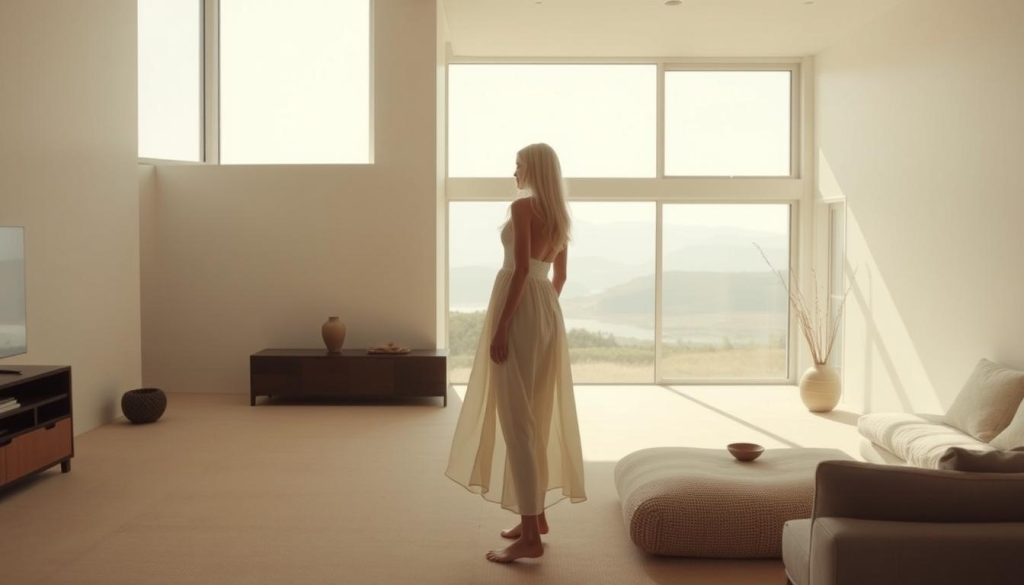
See how form and light shape calm interiors and thoughtful products that actually make life easier. I want you to spot the patterns that make spaces and objects feel reliable and uplifting!
Interior essentials: form, light, geometric shapes, and lines
Start with flow and light. Let rooms breathe and guide movement with clear, geometric shapes that feel intentional.
Keep surfaces clean and storage smart so your interior stays calm and usable. Choose a focused palette and repeat shapes for coherent, confident rooms.
Bring texture with natural materials and warm lighting. That adds depth without clutter and keeps your space inviting.
Study classics like Braun’s T3 Pocket Radio (1958). Its controls are pared back. Interactions are obvious. Beauty sits in restraint.
Contemporary Scandinavian-influenced watches, such as LARSEN & ERIKSEN, pair minimalist aesthetics with Swiss-part movements. They feel precise, unisex, and everyday-ready.
- Look for designers who obsess over clarity, durability, and timelessness.
- Curate a range of essentials that cover needs without overlap—quality beats quantity!
- Build rooms around function first, then add personality with purposeful accents you love.
“The result is a home and toolkit that support your energy, your goals, and your best self!”
Digital Minimalism: UX, UI, and Typography That Put Users First
A clean interface helps users move faster by showing only what matters next. This is the heart of good digital practice: remove the extras and guide attention to the goal!
Streamlined navigation cuts confusion. Keep menus short and predictable so users never guess where to go. Reduce steps and make the path to value obvious!
Use clear visual hierarchy, spacing, and contrast to show what’s primary and what’s secondary. Buttons, headings, and microcopy should point the way without shouting.
Typography choices: sans-serif clarity, ample white space, legibility
Choose sans-serifs like Helvetica, Futura, or FF DIN for on-screen clarity. Bigger line-height and roomy margins let content breathe and help reading speed.
Case-led patterns inspired by Apple and Google’s focus on essentials
Apple and Google put essentials up front: concise content, fast performance, and accessible controls. Follow those patterns—test, iterate, and measure with real users!
- Design for focus—remove extra steps and shrink choices.
- Let hierarchy and spacing guide attention without clutter.
- Prioritize performance and accessibility—fast, inclusive experiences win.
- Treat every pixel like it costs attention; if it doesn’t serve the goal, it’s gone.
“When your interface is simple and intentional, users feel it—and they stick around!”
Minimalism, Life, and the World: Does “Less” Solve “More”?
When you trade abundance for intention, your attention becomes your biggest asset. You start to notice time, relationships, and energy as scarce resources worth protecting.

Consumerism vs. conscious choice: the lifestyle impact
Choosing minimalism in life means opting out of endless consumerism and into values-led decisions! You buy less and choose better, so items last and matter.
Scandinavian habits show this: less stuff, more light, and richer daily rhythms. Vernon Howard summed it perfectly:
“You have succeeded in life when all you really want is only what you really need.”
Focus, stress reduction, and valuing experiences over things
Fewer possessions clear physical and mental space. Your focus sharpens and stress falls.
- Less clutter, more clarity: you feel energy for what excites you.
- Prioritize experiences: memories grow, storage shrinks.
- Authenticity: your choices match your values and pace.
| Shift | Action | Result |
|---|---|---|
| Consumerism → Conscious choice | Buy fewer, better items | Less waste, more meaning |
| Distraction → Focus | Simplify routines and spaces | Improved attention and creativity |
| Possessions → Experiences | Spend on travel, time with people | Deeper satisfaction and resilience |
Conclusion
What started in mid-century studios now guides how we make spaces and products! I see minimalism as a practical compass that blends history, craft, and purpose.
Art and the work of 1970s artists taught restraint. Geometric shapes and simple shapes still steer clarity. Use that lesson when you edit objects, screens, or rooms.
Great designers pair discipline with empathy. Remove one distraction, refine one flow, choose one better solution today. Small edits add up fast and make your life work better.
Keep iterating with courage and joy! Let clarity lead your next move and make every choice count.
Discover the transformative power of authentic healing crystals from Conscious Items, designed to align your spirit and connect you with nature’s energy. With over 500,000 satisfied customers and a 4.9/5 Trust pilot rating, don’t miss out on finding your perfect crystal—shop now before these unique treasures are gone! Take their exclusive crystal quiz today at Conscious Items to uncover your spiritual muse.
If you liked reading this article you will love this article Crystal Healing Properties: Unlock White Crystal Power!
Elevate your spiritual journey with Conscious Items’ genuine gemstones, trusted by thousands and backed by a 30-day money-back guarantee. Don’t let these powerful crystals pass you by—stocks are limited, and the perfect one for you is waiting! Visit Conscious Items now to find your crystal match before it’s too late.
If you liked reading this article you will love this article Minimalism Checklist: The ONLY Checklist you need
Morganite Crystal Healing Properties
Habits of Healthy Relationships: 10 Keys to Lasting Love: The Ultimate Love Stone for Heart Healing