

Ever wondered why a square on a wall can feel like a thunderclap? That question flips what you think about modern work and makes you look again!
I’ll guide you through a clear roadmap that makes the movement click fast. It began in the USA in the late 1950s and surged through the 1960s and 1970s. Artists used simple geometry—squares, rectangles—and a bold idea: the object is its own reality.
Frank Stella’s line, “What you see is what you see,” became a rallying cry. Pioneers like Carl Andre, Dan Flavin, Donald Judd, Sol LeWitt, Agnes Martin, and Robert Morris pushed how works are made, shown, and valued.
This intro will energize you! You’ll learn why less feels intense, how this shift shook the art world, and why the term changed how we read form and space.
Key Takeaways
- Origins: The movement rose in the late 1950s and peaked in the 1960s–70s in the USA.
- Core idea: Work stands on its own—no mimicry of the outside world.
- Look for geometry: Squares and rectangles are signature forms to spot.
- Big names: Learn a few artists and you’ll recognize major works instantly.
- Lasting impact: This shift still reshapes how we see modern art and space today.
What Is Minimalism Art? A Clear, No-Jargon Definition
Here’s a straight, no-jargon explanation you can actually use. I want you to see the idea plainly and feel why it changed how people look at work!
From abstraction to an extreme
Simple definition: this movement strips away stories and shows the thing itself—materials, edges, and presence. It grew out of abstract art but pushed the idea until only form remained.
“What you see is what you see.”
What you see is what you see.
Think clean canvases, plain painting surfaces, and basic geometric shapes like squares and rectangles. The work refuses to imitate outside reality. It declares its own reality—scale, color, weight—right there for you to feel.
- No symbols or drama. Just materials and presence.
- Focus on how form and space change what you notice.
- Meaning comes from direct experience, not hidden stories.
The Hidden Truths: Why Minimalism Art Disrupts the Art World
Stripped-down work forced the art world to face materials and presence head-on! This shift removed biography and metaphor so the object could claim attention.
Artists stopped telling stories. They favored factory-like finishes, steels, aluminum, and fluorescent light. The result? Works that feel like commodities on purpose.
Stripping symbolism and biography to foreground the object
No backstory, no decoding. You aren’t hunting for hidden meaning. Instead, you notice scale, edge, and how light shapes the room.
Anonymity, industrial finish, and the challenge to “fine art” appeal
The anonymous look erases the artist’s hand. That’s intentional. It challenges what fine collections can be and upends value systems.
- The movement flips expectations: pure presence, pure clarity.
- Industrial materials wear their truth—exactly what they are.
- The directness wakes you up and makes the experience active!
Origins in New York: Late 1950s to the 1960s Breakthrough
A new mood took hold in New York as artists pushed back against loud gestures and grand drama. Young painters and makers wanted clarity and presence over personal myth!
Turning away from Abstract Expressionism’s drama
Artists rejected flourish and spectacle. They favored flat surfaces, measured rhythm, and a calm insistence on the object itself.
Frank Stella’s Black Paintings at MoMA (1959)
Frank Stella’s Black Paintings, shown at MoMA in 1959, marked a clear pivot. The striped canvases emphasized flatness and rule-based composition over emotive brushwork.
What you see is what you see.
New York’s scene and the rise of a movement
The 1960s scene caught fire fast. Studios, lofts, and galleries staged one bold exhibition after another.
- New York became the launchpad for a nationwide shift.
- Canvases and objects moved toward precision and repetition.
- The term gained purchase as critics and curators tracked these changes.
| Year | Event | Impact |
|---|---|---|
| 1958–60 | Frank Stella’s Black Paintings | Shift to flatness and seriality in painting |
| 1959 | MoMA exhibition | Public recognition and critical debate |
| 1960s | Gallery and museum shows across New York | Movement spreads nationally and internationally |
Key Characteristics of Minimalist Art
Feel the rules at play: this section breaks down the qualities that give these works their steady power. You’ll get the essentials—order, material truth, and how scale involves you!
Repetition and modular systems
Expect repeated modules that sharpen attention. Series and stacks reveal tiny shifts as you move. Repetition becomes a meditative device, not monotony.
Geometric forms and grids
Clean shapes and grids create calm order. These geometric forms calm visual noise and let form speak plainly.
Non-objective meaning and material truth
No story to decode. The focus is on material honesty and surface. The work shows itself and asks you to respond.
Industrial materials and prefabrication
Steel, aluminum, and fluorescent light give a cool, precise presence. Prefab methods highlight process and remove painterly gesture.
Emphasis on real space, scale, and the viewer’s body
These works ask you to move, measure, and feel weight and distance.
- Pieces alter how the room reads and how you stand or walk.
- Sculpture and installations use scale to make the viewer active.
- The result opens mental space and restores focused calm!
Minimalism and Earlier Abstraction: From Constructivism to Suprematism
Before the white cube, other experiments taught artists how to strip form to essentials. You’ll see a clear line from early 20th-century work to the cool, factory-like pieces you know today!
The 1962 English edition of The Great Experiment in Art helped spread knowledge of Russian Constructivism and Suprematism. Those movements praised essential structures and factory production. That idea fueled later studio methods and public displays.
Russian avant-garde influences and factory methods
Tatlin, Rodchenko, Malevich mattered. Dan Flavin honored Tatlin. Robert Morris referenced Tatlin and Rodchenko. Donald Judd wrote about Malevich. They all showed how modules and production could be part of making.
De Stijl, Bauhaus, and the flat picture plane
Mondrian and Albers taught artists to trust grids, flat surfaces, and system. De Stijl and the Bauhaus pushed clarity and repeatable design. That fed into how later painters and sculptors worked with scale and surface.
“Essential structure and factory methods gave form to ideas that later became central.”
- Lineage: earlier movements supplied logic and design.
- Focus: grids, modules, and clear forms shaped new practice.
- Result: concepts moved into real space as painting and sculpture.
| Movement | Key Figures | Influence |
|---|---|---|
| Constructivism & Suprematism | Tatlin, Malevich, Rodchenko | Factory logic, essential forms, modular thinking |
| De Stijl | Mondrian | Grid systems, flat plane, color order |
| Bauhaus | Albers and Bauhaus faculty | Systematic design, materials, teaching methods |
Minimalism vs Abstract Expressionism: A Clean Break
You’ll see how a sharp break redefined what a painting or sculpture can be. This moment split two ways of working and changed how you meet a piece in a room!
Rejecting gesture, emotion, and biography
Artists who led the new movement said no to splashy gestures and theatrical feeling. They removed the hand, the story, and the melodrama. What remained was cool presence and raw material honesty.
The result feels stripped-down but powerful. You face an object that asks you to notice scale, edge, and space—right now!
Clement Greenberg’s formalism and the reaction
Clement Greenberg argued for purity: keep painting pure and separate from sculpture. Minimalists pushed back hard. They blurred the line between painting and sculpture and erased old medium rules.
What mattered was experience, not the artist’s signature.
- No spectacle: clarity, discipline, and presence win.
- Object first: the piece stands on its own, not as a biography.
- New possibilities: painting and sculpture meet and expand together.

Minimalism Art: The Movement’s Defining Artists
Meet the makers whose rules reshaped how we look at shape, size, and space! I’ll introduce key names so you know who set the tone and why their choices still matter.
Frank Stella, Donald Judd, Robert Morris
Frank Stella insisted, “What you see is what you see.” His paintings push direct seeing.
Donald Judd made precise stacks and wrote essays that shaped practice.
Robert Morris wrote Notes on Sculpture and made mirrored cubes that fold the viewer into the work.
Carl Andre, Sol LeWitt, Dan Flavin
Carl Andre put modules on the floor—bold, physical, and matter-of-fact.
Sol LeWitt turned systems into visual beauty with modular cubes.
Dan Flavin sculpted with fluorescent light and changed how rooms read.
Agnes Martin, Tony Smith, and peers
Agnes Martin used quiet grids to show subtle feeling through discipline.
Tony Smith made monumental forms that make your body map the space.
Together these artists rewired painting, sculpture, and installation for a whole movement!
- Quick take: they set rules, materials, and scale as the point.
- These figures made works that ask you to move, measure, and feel.
Iconic Works and Why They Matter
These landmark works show how a few rules can flip what you notice in a room. They teach you how scale, material, and placement become the subject!
Frank Stella — Die Fahne Hoch! (1959)
Frank Stella reduced painting to pattern and surface. The black stripes reveal raw canvas and force the painting to be a physical object.
Tony Smith — Die (1962)
This six-foot steel cube is tuned to the human body. Walk around it and your senses measure its weight and scale. The piece makes the room register as part of the work.
Carl Andre — Lever (1966)
Carl Andre laid 137 firebricks across the floor. The line interrupts your path and redirects attention. The floor becomes a field for decision, not just display.
Robert Morris — Untitled (mirrored cubes) (1965–71)
Robert Morris used reflection to fold the viewer into the composition. Your image and the surroundings become active parts of the sculpture.
Donald Judd — Untitled “stacks” (1960s–70s)
Donald Judd repeated prefabricated units up the wall. The stacks turn the wall into measured rhythm and blur painting with sculpture.
Dan Flavin — Untitled (in honor of Harold Joachim) 3 (1977)
Flavin used fluorescent tubes to paint with light. The colored glow shapes the room and proves that illumination itself can be sculptural.
These works change how you move, where you pause, and what details you notice.
Why they matter: together these works remake the exhibition into an active experience. You, the viewer, become the measure of space and meaning!
Materials, Mediums, and Methods
Industrial materials turned into visual language—strong, honest, and immediate. I want you to feel how metal and light do the talking here!
Artists chose aluminum, steel, fiberglass, and fluorescent tubes for a reason. These materials are durable and plain. They refuse ornament and point to presence.
Aluminum, steel, fiberglass, fluorescent light
Why these choices matter: the surface reads as fact. Prefabrication keeps the maker’s hand quiet. The finish is smart and industrial.
Logical procedures and mathematical systems
Designs often follow rules and simple algorithms. Grids, ratios, and repetition guide decisions. That clarity becomes the work’s voice.
Painting, sculpture, installation, and beyond
These concepts move freely across medium and scale. You’ll see factory-made panels, stacked modules, and rooms lit as if they were sculptures. The method matters as much as the final piece!
“Process shows in the product; systems become the visible poetry.”
| Material | Typical Use | Effect |
|---|---|---|
| Aluminum | Panels, frames | Lightweight precision, cool sheen |
| Steel | Structural stacks, large sculpture | Weight, industrial presence |
| Fluorescent light | Room-scale installations | Color, atmosphere, spatial shift |
| Fiberglass | Curved forms, prefabs | Smooth finish, molded repeatability |
- Quick take: systems over gesture!
- Materials speak. The medium becomes method.
- You leave seeing process as part of the wow!
Viewer, Space, and Object: Experiencing Minimalist Exhibitions
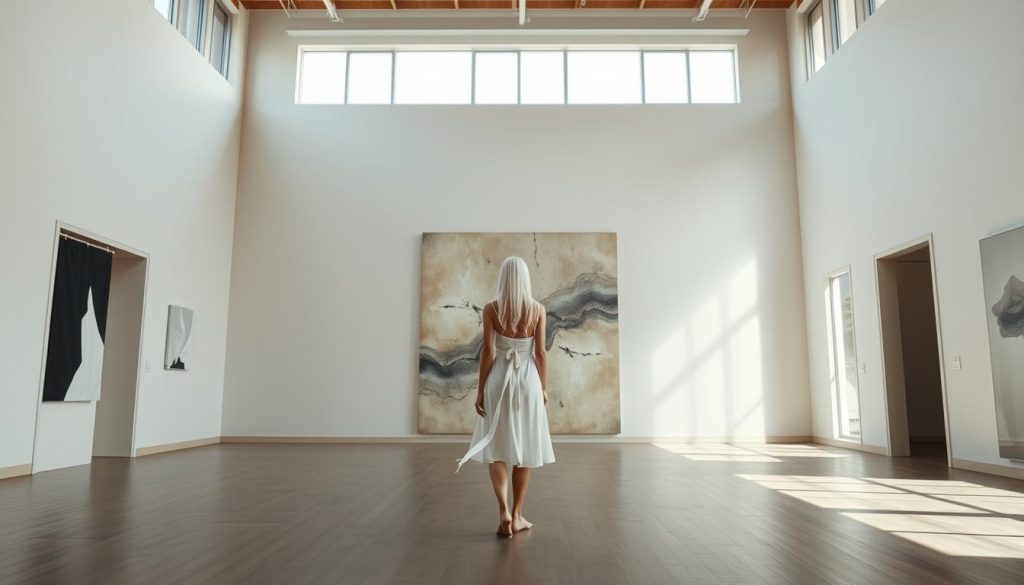
When you walk into a gallery, the work often asks your body to decide what to notice next. You become an active viewer, not a passive onlooker! The room, the piece, and you form a live triangle of attention.
Kinesthetic responses: weight, height, gravity, light
Move close and you feel weight and scale differently. Step back and the height shifts your read of the object. Light becomes material—flats and shadows change how the piece sits in the room.
These moments are physical. Your posture, walk, and pause complete the work. That kinesthetic reply makes the exhibition feel theatrical and immediate.
From wall to floor: breaking pedestals and frames
Many works come off the wall and sit on the floor. Frames and pedestals disappear. The object meets your path and reroutes how you move through space.
Result: the exhibition becomes a designed field for you to explore. Edges, shadows, and distances grow sharp. Stand closer. Circle around. Your motion finishes the piece.
“You, the viewer, the room, and the object make a single live moment.”
| Experience | What You Do | Effect |
|---|---|---|
| Kinesthetic sensing | Walk, lean, pause | Perceive weight, height, gravity |
| Spatial activation | Move through the room | Space reshapes your path |
| Object placement | Approach floor or wall pieces | Frames vanish; contact increases |
- You leave more awake to space and more present in daily life!
- The viewer is central: your movement completes the sculpture and the exhibition.
Dialogues with Conceptual Art and Post-Minimalism
A new conversation began that asked one blunt question: does the idea outweigh the physical object? This shift opened doors and sparked experimentation! You’ll see how strict systems met writing, instructions, and new formats.
Challenging how art is made, shown, and understood
Conceptual art pushed the claim that an idea can be the work. Artists used text, plans, and actions to prove a point. Galleries had to rethink what they could show and sell.
That disruption forced collectors, curators, and audiences to ask new questions. What counts as a work? Who owns the concept? The result was thrilling and messy.
From Minimalism’s rigor to Post-Minimalism’s pushback
By the late 1970s, Post-Minimalism softened rigid rules. Process, imperfection, and chance entered the studio. These moves honored the earlier clarity while widening its reach.
“Clarity breeds innovation—ideas and objects feed each other.”
- Minimalism opened doors for conceptual art to ask: idea or object?
- Both movements redefined how works are made, shared, and valued.
- Post-Minimalist artists favored process-driven formats that blurred painting and sculpture.
| Shift | Key Voices | Impact |
|---|---|---|
| Idea over object | Sol LeWitt | Instructions and plans as valid works |
| Wall to process | Robert Morris | Materials and contingency enter practice |
| Object clarity | Donald Judd | Rigor in form that informed later loosened practice |
Global Currents and Contemporary Reach
You can trace a global thread where stillness, simple shapes, and ritual sensibility meet modern display. This current ties religious silence and modern design into a shared visual habit you notice fast!
Zen and nonfigurative religious traditions fed a taste for emptiness and calm. Some historians point to Hindu ideas of nothingness as another source of quiet focus. Agnes Martin herself acknowledged a Zen-like clarity in her grids.
From spiritual sources to everyday design
Today, the movement’s DNA shows up across the world in interiors, architecture, and fashion. Clean lines and open space make rooms breathe. Product design borrows those steady forms and clear functions.
- Stillness and simple forms travel easily across cultures.
- Shapes and scale create calm in homes and galleries.
- This is a mindset, not a trend: less clutter, more intention!
Small forms can change how you live and how you think.
Debates, Critiques, and Misconceptions
People ask, “Is this even art?” and that doubt is exactly where the debate gets interesting! I love that question because it pushes you to think and feel, not just judge.
“Is it art?” Meaning, simplicity, and the charge of emptiness
Critics sometimes mock plain shapes as empty. Others call them profound. Both responses matter! The push-and-pull forces a public conversation about meaning and value.
Simplicity is not lack. It is choice. It strips noise and focuses on material, scale, and light. That clarity reveals hidden depth as you stay with a piece.
The power and complexity within restraint
Restraint has muscle: it sharpens perception, builds calm, and creates order in a noisy world. The artist steps back so you can step forward.
“The idea that reality—materials, scale, light—can be meaningful is powerful.”
- Questioning “is it art?” becomes part of the experience.
- Simplicity reveals subtle qualities through attention.
- Conceptual art debates expand what an art form can be.
Stay curious! The controversy is an on-ramp to deeper seeing and richer living. Let the work work on you.
Conclusion
Here’s how the movement’s clarity can sharpen your days, rooms, and attention! Take the essentials: it began in New York in the late 1950s and 1960s and broke with abstract expressionism to favor objects, industrial materials, and measured form.
Key figures—Frank Stella, Donald Judd, Robert Morris, Carl Andre, Sol LeWitt, and Agnes Martin—built a language where painting and sculpture meet the viewer in real space.
Look for geometric shapes, the canvas as object, and works that demand motion. Slow down, step close, and let the room teach you. Apply this clarity at home: edit clutter, choose simple forms, and make space feel intentional!
Discover the transformative power of authentic healing crystals from Conscious Items, designed to align your spirit and connect you with nature’s energy. With over 500,000 satisfied customers and a 4.9/5 Trust pilot rating, don’t miss out on finding your perfect crystal—shop now before these unique treasures are gone! Take their exclusive crystal quiz today at Conscious Items to uncover your spiritual muse.
If you liked reading this article you will love this article Crystal Healing Properties: Unlock White Crystal Power!
Elevate your spiritual journey with Conscious Items’ genuine gemstones, trusted by thousands and backed by a 30-day money-back guarantee. Don’t let these powerful crystals pass you by—stocks are limited, and the perfect one for you is waiting! Visit Conscious Items now to find your crystal match before it’s too late.
If you liked reading this article you will love this article Minimalism Checklist: The ONLY Checklist you need
Morganite Crystal Healing Properties
Habits of Healthy Relationships: 10 Keys to Lasting Love: The Ultimate Love Stone for Heart Healing