
one-sided relationship signs Ever feel like you’re doing all the work while your partner just relaxes? That’s a sign of a one-sided relationship. It’s time to take a closer look. When the effort isn’t equal, it can cause big problems.
These problems include feeling resentful, lonely, and even anxious. Let’s look at 13 signs to see if you’re in an unfair relationship. It’s time to take control of your love life! One Sided Relationship Signs: 13 Red Flags to Watch For
Key Takeaways
- Initiating most of the communication and activities in the relationship1
- Making major decisions alone without your partner’s input1
- Being the one who always has to apologize after conflicts1
- Feeling like you have to sacrifice your own needs to make your partner happy1
- Experiencing poor communication and a sense of not knowing where you stand1
Understanding One-Sided Relationships: Definition and Impact
A one-sided relationship is when one person gives a lot more than the other. This can make the person giving feel unhappy and stressed2.
What Defines a One-Sided Relationship
In a one-sided relationship, there’s no balance. One person tries hard to talk and connect, but the other doesn’t2. This makes the person trying feel lonely and upset3.
The Emotional Toll of Imbalanced Relationships
Being in a one-sided relationship can really hurt your feelings. You might feel angry and tired because you’re not getting what you need2. This can make you feel stressed, less confident, and like you’re not loved3.
How One-Sided Relationships Affect Mental Health
Being in a one-sided relationship can mess with your mind. You might feel anxious, sad, and have trouble sleeping2. It can also make your body sick and hurt your health3.
It’s important to know if your relationship is one-sided. This helps keep your feelings safe and your health good234.
| Key Characteristics of One-Sided Relationships | Potential Emotional and Mental Health Impacts |
|---|---|
|
|
“The stress and emotional turmoil of a one-sided relationship can have a profound impact on mental and physical well-being.”
One Sided Relationship Signs You Shouldn’t Ignore
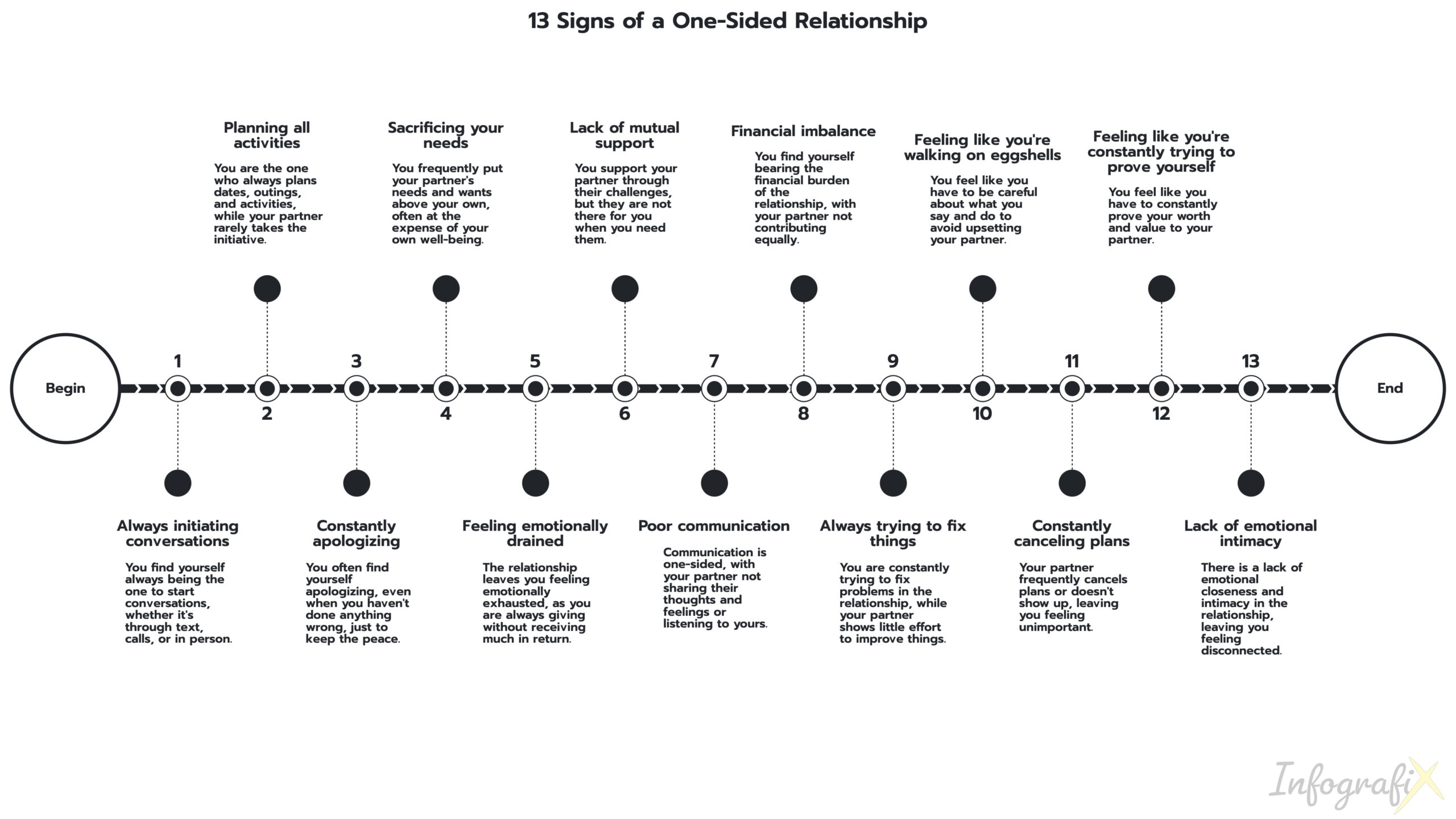
It’s important to know if your relationship is one-sided. If you always plan things and talk first, it might be a sign. Feeling nervous about saying “I love you” or always saying yes to your partner are also red flags5.
Another sign is if your partner doesn’t care about your life. If they cancel plans a lot or say work is always busy, it’s a problem5.
- If you always say sorry and want to fix things, it’s a sign of a one-sided relationship5.
- When your partner chooses work over you, it shows they’re not fully committed6.
- Feeling like you’re always careful around your partner can mean there’s a power imbalance6.
Talking about these relationship red flags, like unbalanced effort and selfish behavior, early can help. By spotting these signs, you can try to fix things or decide if it’s time to move on5.
“Healthy relationships are built on mutual respect, trust, and a willingness to work through challenges together. If you find yourself constantly giving more than you’re receiving, it may be time to reevaluate the dynamic.” – Relationship Counselor, Jane Doe
The Burden of Unequal Emotional Investment
In a one-sided relationship, one person often feels left out. This can lead to emotional neglect, where one person’s feelings are ignored7. People with different attachment styles can also play a big role. Some may not care as much, while others may care too much7.
Signs of Emotional Neglect
Signs of emotional neglect are clear. You might always try to please your partner and feel bad about yourself7. If you always say sorry, don’t get support, or hide the relationship, it’s a warning sign7.
Impact on Self-Esteem
Being in a one-sided relationship can really hurt your self-esteem. Feeling ignored and always giving without getting anything back can make you doubt yourself8. It can make you feel alone, anxious, and sad, and make you doubt future relationships8.
Patterns of Emotional Dependency
Emotional neglect can make you cling to your partner. You might hope that things will get better7. This can lead to a cycle of codependency, which is very harmful8.
It’s important to recognize these signs to stay emotionally healthy. Talking openly with your partner and seeking help from a therapist can help7.
Communication Patterns in Imbalanced Relationships
In one-sided relationships, talking can be hard. One person might not want to talk deeply or listen to the other. This makes it hard to share feelings9.
The person who cares more might feel scared to share their feelings. They might worry about being judged or causing trouble10.
This problem shows that the relationship is not healthy9. It’s hard to find a way to talk that works for both. One person might talk too much, or the other might not want to talk at all10.
This leads to feelings of not being heard, anger, and feeling far apart. It can really hurt the relationship10.
It’s important to notice these talking problems. This helps fix the imbalance and make the relationship better9. Talking openly and trying to see things from each other’s point of view is a good start10.
“Effective communication is the foundation of any healthy relationship. When that foundation cracks, the entire structure becomes unstable.”
To fix talking issues in one-sided relationships, you need to be willing to work hard. You need to be patient, open, and really want to grow together9. By focusing on understanding each other and fixing the imbalance, you can make your relationship better and more open10.
The Role of Boundaries and Control
Healthy boundaries are key in good relationships. But, in one-sided ones, they often get ignored11. This makes us feel used and shows a lack of respect12.
Setting Healthy Boundaries
It’s important to learn about setting and keeping healthy boundaries. You need to talk clearly about what you need and want. And you must be ready to stand up for yourself11. But, if your partner gets mad when you try to set boundaries, it might mean there’s a big problem11.
Recognizing Control Tactics
One-sided relationships often use sneaky ways to control, like making you feel guilty or changing your mind12. It’s important to know these tricks to keep your self-respect12.
Standing Up for Your Needs
Being assertive is crucial in fixing an unbalanced relationship. You should talk clearly about what you need and set limits. Don’t let unfair or rude behavior go unnoticed11. If your partner won’t listen and change, you might need to get help or think about leaving12.
“In a one-sided relationship, setting boundaries is crucial for reducing conflict and misunderstandings, as per Kim’s analysis. However, if one party reacts negatively or gets angry when boundaries are set, it can signal an imbalance in the relationship.”
Keeping healthy boundaries and standing up for yourself is vital in fixing an unbalanced relationship. By spotting control tricks and being clear about your place, you can start to make things better. You’ll find the balance and happiness you deserve111213.
| Healthy Boundaries | Control Tactics | Assertiveness |
|---|---|---|
| Clear communication of needs | Guilt-tripping | Clearly expressing your needs |
| Respecting each other’s limits | Manipulation | Setting and maintaining boundaries |
| Mutual understanding and compromise | Gaslighting | Refusing to accept unfair treatment |
Financial and Practical Imbalances in Relationships
Keeping a relationship balanced needs open talks and shared tasks. But, money and practical issues can show a one-sided relationship. This means one person always pays or does all the chores, causing resentment14.
Money problems and hiding money are big issues. They can lead to stress and make talking hard in a relationship14. Feeling guilty about money differences can make things worse14.
Unequal tasks in a relationship are also a warning sign. If one person always plans and pays, while the other does their own thing, it’s not fair15. This pattern shows one person is not trying to keep the relationship balanced15.
Talking openly about money and tasks is key to a good relationship. It’s important to share money plans, agree on spending, and make a budget together14. Keeping track of time and effort can help show if things are balanced15.
For a relationship to thrive, both must try their best. It’s not about being equal, but about both doing their best16. If trying to fix the imbalance doesn’t work, it’s time to focus on your own well-being15.

“A healthy and thriving relationship is described as both partners putting in their best effort, aiming for a 100/100 commitment rather than a 50/50 split.”16
Breaking the Cycle of Codependency
Freeing yourself from codependency starts with knowing your worth17. It comes from a bad upbringing where you put others first. You learn to ignore your own needs and always seek approval17. Knowing your value helps you start building a better relationship.
Understanding Your Worth
Codependents often feel bad about themselves because of what others say17. It’s time to change this and know you deserve respect and kindness from everyone, including yourself17. Learning to say “no” and setting boundaries is key to finding yourself.
Steps Toward Relationship Balance
To have a balanced relationship, talk openly and understand each other18. Don’t just accept bad behavior from your partner. Instead, tell them what you need without fear18. A good relationship is based on respect, trust, and growing together.
When to Seek Professional Help
If you can’t break free from codependency alone, get help from a counselor17. A therapist can teach you how to set boundaries and support your growth17.
Being brave and putting your needs first is the first step to freedom from codependency. With the right mindset and support, you can create better, more fulfilling relationships.
Common Causes of One-Sided Relationships
Relationship patterns, attachment styles, and personal history can lead to one-sided relationships. These imbalances often come from unmet emotional needs, communication issues, and a lack of mutual support19.
Mismatched expectations are a big factor. One partner might give more emotional support, time, or effort than the other19. Poor communication can also cause misunderstandings or one partner not sharing their needs. This can lead to an unseen imbalance19.
Problems like commitment anxiety or unresolved past issues can make one partner emotionally distant. This can lead to an imbalance of power where one person makes all the decisions19. When one partner always takes emotionally without giving back, it can cause resentment and a lack of mutual support19.
When one partner depends too much on the other for identity or emotional support, it’s called unequal dependence. Misaligned relationship priorities can also make one person feel ignored or used19. Stress from work or family can also cause one partner to pull away, affecting the relationship19.
Finally, unresolved past problems can lead to unbalanced interactions and a lack of real connection between partners1920. Knowing these causes is key to fixing the imbalance in one-sided relationships20.

Conclusion: Moving Forward from One-Sided Relationships
Dealing with a one-sided relationship can be hard. But, by thinking deeply about yourself and growing, you can move on21. It’s key to focus on your feelings and find relationships with respect and balance21.
Whether you try to fix the current relationship or start anew, aim for healthy ones. These should help you grow and feel happy.
Knowing when a relationship is one-sided is the first step22. Look for signs like not getting back what you give, feeling drained, and not being able to express yourself22. By setting boundaries and focusing on yourself, you can regain your self-worth22.
This leads to relationship growth, self-improvement, and healthy partnerships.
You should have a relationship where both people are happy and contribute equally23. Getting help from a therapist can really help23. With time and care for yourself, you’ll come out stronger and ready for better relationships.
Live A Supercharged Life YOUTUBE CHANNEL:
Check Out my blog: https://www.liveasuperchargedlife.com/
Checkout my podcast channewl:
The entire article “The Impact of One-Sided Love: Why It Hurts and How to Heal“
FAQ
What defines a one-sided relationship?
What are the emotional consequences of an imbalanced relationship?
What are the common signs of a one-sided relationship?
How does emotional neglect manifest in one-sided relationships?
What are the communication challenges in imbalanced relationships?
How can healthy boundaries help in a one-sided relationship?
What are the signs of financial and practical imbalances in a relationship?
How can one break free from the cycle of codependency in a one-sided relationship?
What are the common causes of one-sided relationships?
Source Links
- One-Sided Relationships Are the Worst, Here’s How to Cope
- One-Sided Relationship: Signs & How to Fix it — Talkspace
- How Do You Know You’re In a One-Sided Relationship?
- One-sided relationships: Signs, effects and more
- Recognizing the Signs of a One-Sided Relationship and How to Fix It
- 12 Signs You’re Trying to Force a Relationship That Just Isn’t Right
- 6 signs that you’re in a one-sided relationship and how to find balance
- Can I Save My One-Sided Friendship? The Experts Say…
- Is My Relationship One-Sided?
- 10 Warning Signs That You’re in a One-Sided Relationship
- Are You In A One-Sided Relationship? 20 Major Red Flags
- One-Sided Relationships | Clear Behavioral Health
- What a One-sided Relationship is and How to Fix It.
- 13 Practical Ways to Deal With Money Imbalance in Relationships
- Are You in a One-Sided Relationship? Here Are 7 Warning Signs, According to Experts
- 7 Signs of Being in a One-Sided Relationship
- 23 Signs of Codependent Behavior in a Relationship
- Codependency: Signs of a Codependent Relationship
- Online Counselling | Online Therapy| Marriage Counsellors | TalktoAngel
- Are You In A One-Sided Relationship? 20 Major Red Flags
- Are You In A One-Sided Relationship? 20 Major Red Flags
- 10 Signs You’re in a One-Sided Relationship
- Dealing with One-Sided Love: Coping & Moving Forward